

There are many different types of sensors, and there is a component proximity sensor that has the ability to "sense" the proximity of an object close to it - the proximity sensor. Proximity sensors are used for the purpose of controlling the switch on or off by using the sensitive characteristics of the proximity sensor to the approaching object. When an object moves towards the proximity sensor and approaches to a certain distance, the proximity sensor will have "sense" and the switch will act. This distance is usually called the "detection distance". However, different proximity sensors have different detection distances. Sometimes the detected objects are moved to the proximity sensor one by one and left one by one at certain time intervals, and this is repeated over and over again. Different proximity sensors have different response capabilities to the detected objects.
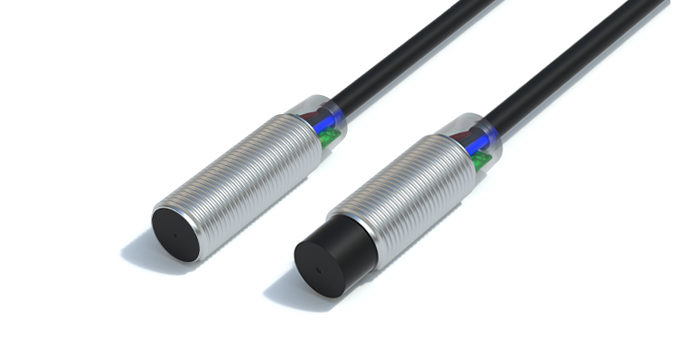
Proximity sensor, also known as a contactless position switch, is a position switch that can be operated without mechanical contact with moving parts. When a moving object is close to the switch to a certain position, the switch sends a signal to achieve the role of travel control, counting and automatic control. Compared with travel switches, proximity sensors have the advantages of high positioning accuracy, reliable operation, long life, high operating frequency and the ability to adapt to harsh working environments. However, the proximity sensor requires a contact relay as the output when used. Detailed characteristics are as follows.
1. Dynamic characteristics of proximity sensors
The so-called dynamic characteristics of the proximity sensor is the switch near the output characteristics when the input changes. In practice, some dynamic characteristics of the commonly used standard input signal are switched to show the echo. This is due to the proximity sensor to the standard input signal echo to test the way to obtain and near the switch specification of the input echo signal and the inevitable link between the arbitrary input signal echo, usually knowing that the former can presume the latter. Step signals and sine signals are most commonly used and input signal specifications, so the dynamic characteristics of the near switch are also commonly displayed by step echoes and frequency echoes.
2. Sensitivity of proximity sensors
The sensitivity of the proximity switch to changes in the output of steady-state operation, the rate of change of the input. It is the slope of the output of the input characteristic curve. If there is a significant linear relationship between the input and output of the proximity sensor, the proximity sensor is of a constant sensitivity. Otherwise, the sensitivity of the switch varies with the input. The size sensitivity of the switch is the size output, the rate of the input. For example, a proximity sensor, in the proximity change of 1 mm, 200mV sensitivity and the output voltage change is proximity sensor should be labeled as 200mV/mm. When the output switch is close to the size of the input phase, the sensitivity of the proximity sensor can be interpreted as the expansion ratio. The sensitivity to the switch, a higher measurement accuracy can be obtained. However, the sensitivity of the proximity sensor is high, the measurement range is narrow, and the stability is poor.
3. Switching resolution
The resolution of the switch is what the switch can feel is measured to the smallest change. That is, if the input from a non-zero value to change slowly. When changing the input value near the switch does not exceed a certain value, the output of the proximity sensor does not change, i.e., near the switch which is not out of the resolution of the change in the input quantity. Only when the change of the input to the switch exceeds the resolution, the output will change.
4. Linearity of proximity sensors
Usually, the output of the switch is close to the static characteristic curve, rather than a straight line in practice. In practice, in order to make the appearance of uniform scale readings near the switch, usually a fitted straight line approximates the practice characteristic curve represented by the linear error (linearity) is the degree of approximation of the performance index. There are various ways to choose the straight line fitting straight line. If the proximity sensor input zero and full scale output is connected to the theoretical straight line fitting straight line; or the characteristic curve of the error squared and the minimum theoretical straight line fitting straight line, fitting straight line indicates a linear least squares fit.
5. Switching static characteristics
In the static characteristics of the switch is a static input signal, close to the switch output and input is interconnected. Thereafter the proximity sensor input and output quantities and time independent, so link between them, that is, the proximity sensor static characteristics can be used without the time variable algebraic system of equations, or input variables as the horizontal coordinate, the corresponding output of the proximity sensor as the vertical coordinate, drawing the characteristic curve to describe.