

First of all, limit switches, proximity switches and photoelectric switches are three different principles of sensors, but the role of the same, are used to detect the position.
Limit switches: can also be called travel switches; can be installed on relatively static objects (such as fixed frames, door frames, etc., referred to as static objects) or objects in motion (such as moving cars, doors, etc.). When the object is close to the static object, the linkage of the switch drives the contact of the switch causing a closed contact to break or an open contact to close. The change in the open and closed state of the switch contact controls the action of the circuit and mechanism. Limit switches can also be divided into rotary limit switches and in-line limit switches. Limit switches have mainly mechanical contacts inside, which can be either normally open or normally closed. The contact is passive, so there is no distinction between NPN and PNP, the incoming line is 24V and the outgoing line is also 24V; therefore it is not picky about PLC.
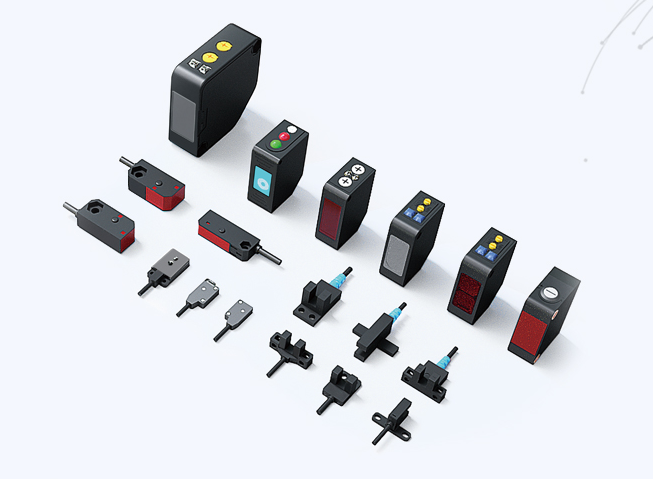
Proximity switch: A sensor that detects position without direct mechanical contact with moving parts and can be operated. Proximity switches are also known as non-contact travel switches, which can perform travel control and limit protection, etc.
The sensor does not require contact with the detecting material, but the material of the detecting material needs to be metal, because it does not require contact with the detection, so it is characterised by reliable operation, long life, low power consumption, high repositioning accuracy, high operating frequency and adaptability to harsh working environments. Proximity switches are divided into PNP and NPN, so when choosing a sensor you need to confirm the PLC connection.
Photoelectric switch; it is used to detect the presence or absence of an object by using the detected object to block or reflect the light beam, which is connected to the circuit by the synchronous circuit. Objects are not limited to metal, but all objects that reflect light (or have an obscuring effect on light) can be detected. There are diffuse reflective switches, counter-switches, etc. Diffuse reflective switches require only one sensor to transmit and receive, whereas counter-switches require two sensors, one to transmit and one to receive.
Photoelectric switches are also available in NPN and PNP versions, but in addition to this photoelectric switches are also available in dry junction, which can be connected to any kind of PLC.
Let's look at the differences between them;
First, shape
Limit switches generally consist of an obvious action part, and the part can move back and forth with different angles of movement, some can be 180 degrees, some can only be 90 degrees.
Proximity switches are simpler and are simply a separate sensor.
Some photoelectric switches have the same shape as proximity switches, but some are completely different and need to have both transmitting and receiving components.
Second, detection distance
Limit switches require direct contact with the detecting substance.
Proximity switches are closer and generally have a detection range of typically 3-20mm, depending on the sensor. The detection distance of a proximity switch is largely related to the diameter of the detection head, i.e. the greater the detection distance, the greater the diameter required.
The detection distance of photoelectric switches is generally very long, some even reaching several metres. This is a distinctly superior feature to proximity switches, but the principle of photoelectric switches and light, then it has an obvious flaw, that is, vulnerable to vapour dust and other influences, once the vapour dust will detect the route blocked, the sensor will fail, while the proximity switch detection of metal does not have this problem.
Third, functions and application occasions
1. limit switch for the mechanical switch, the trial is not very use frequency is not very frequent occasions, in addition, some mechanical switches can be made of all metal, you can work in high temperature occasions, which other sensors can not do.
2. proximity switch life is longer, suitable for "through the signal". The position detection on the cylinder is generally a proximity switch. But because the proximity switch also has an internal circuit, so can not be applied in the strong magnetic interference place.
3. photoelectric switch is the most widely used, only need objects to block the light source can be triggered, so can not be used in dusty places and strong magnetic interference.