

The inductive head of an inductive proximity switch is an inductive coil with a ferrite core, which can only detect metal bodies.
The oscillator generates an alternating magnetic field on the surface of the inductor head, and when a metal object approaches the inductor head, the internal action of the proximity switch is activated, thus achieving "on" and "off" control.
Magnetic Proximity Switches
The magnetic proximity switch mainly refers to the Hall proximity switch, which works on the Hall effect. When a magnetic object approaches the Hall switch, the state of the Hall proximity switch changes, such as from "on" to "off".
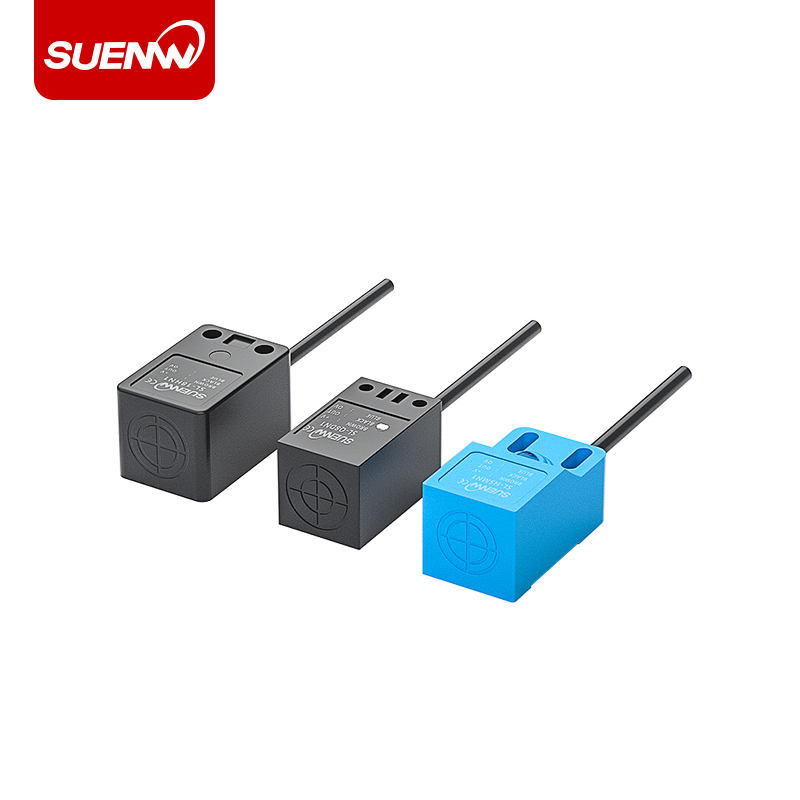
Capacitive Proximity Switch
The sensing head of a capacitive proximity switch is a circular flat electrode that forms a distributed capacitance with the ground of the oscillation circuit. When a conductor or other medium approaches the sensing head, the electric capacity increases and the oscillator stops oscillating and outputs an electric signal through a shaping amplifier. Capacitive proximity switches can inspect metals, non-metals and liquids.
Contactless travel switches, also known as proximity switches, send an "action" signal when an object is approached at a certain distance, without applying mechanical force. The use of proximity switches has gone far beyond the general travel and limit protection of travel switches. They can also be used for high-speed counting, speed measurement, liquid level control, detecting the presence of metal bodies, detecting the size of parts, contactless buttons and as sensors for computers or programmable controllers.
Basic operation of an inductive proximity switch sensor
Induction proximity switch sensor can be detected from the horizontal side of the sensor body of the proximity measurement, and the sensor head can be detected from the vertical access of the body under test. The working distance of the measured body of the proximity sensor switch sensor operating distance; independent operation of the temperature and voltage of the floating body effect from the actual working vertical distance. The operating delay time, the response time will be called when the test body comes into or out of the detection range. In sensor applications, the results of detecting these parameters should be considered whether the actual situation will be affected.
Proximity switches are classified according to their operating principles: high-frequency oscillation type (detecting various metals), permanent magnet type and magnetic sensing element type, electromagnetic induction type, capacitive type, photoelectric type and super-generated wave type, and several others. The commonly used proximity switch is the high-frequency oscillation type, which consists of oscillation, detection, thyristor and other parts.
Working Principle of Induction Proximity Switch Sensor
A proximity switch sensor is a device that senses the proximity of an object. It uses the sensitivity of the displacement sensor to the object it is approaching for the purpose of identifying the object's proximity and outputting a switching signal. Therefore, proximity switch sensors are often referred to as proximity switches.