

Proximity switches are widely used in our production life, and they are very versatile. Today, we are going to introduce one of them - capacitive proximity switch.
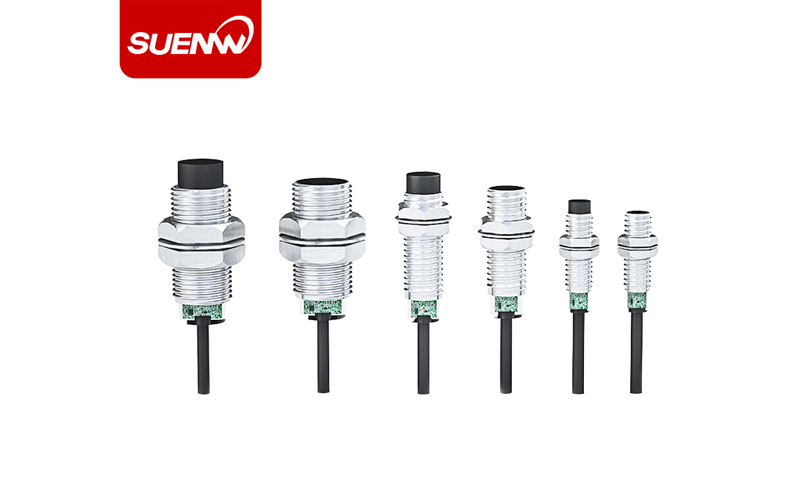
First. Capacitive Proximity Switches
Capacitive proximity switch This type of switch measurement usually constitutes one pole of a capacitor, while the other pole is the housing of the switch. This housing is usually grounded or connected to the housing of the device during the measurement. When an object moves towards the proximity switch, regardless of whether it is a conductor or not, its proximity always causes a change in the dielectric constant of the capacitor and thus a change in the capacitance, which causes a change in the state of the circuit connected to the measuring head, thereby controlling the switch to turn on or off. The objects detected by this type of proximity switch are not limited to conductors, but can be insulated liquids or powders, etc.
Second. Capacitive proximity switch function
The sensing surface of a capacitive sensor consists of two concentrically arranged metal electrodes, which are equivalent to the electrodes of a non-wire-wound capacitor. The surfaces a and b of the electrodes are connected to the feedback branch of a high frequency oscillator, which is adjusted so that it does not oscillate when the surface is free.
When an object approaches the effective surface of the sensor, it enters the electric field in front of the electrode surface and causes a change in the coupling capacitance. The oscillator starts to oscillate and the amplitude of the oscillation is recorded by an evaluation circuit and is converted into a switching command.
Capacitive proximity switches, mainly for detecting non-metallic substances.
Third. Matters to be noted when using capacitive proximity switches
1. The capacitive proximity switch has a 50ms turn-on time, so in the design of the user's product, when the load and the proximity switch use different power supplies, be sure to turn on the power of the proximity switch first.
2. Capacitive proximity switches can theoretically detect any object, but when detecting objects with high dielectric constants, the detection distance is significantly reduced, at which point even increasing the sensitivity will not be effective.
3. When using inductive loads (such as lamps, motors, etc.), their transient inrush currents are large and may deteriorate or damage the AC 2-wire capacitive proximity switch, in which case, please go through the AC relay as a load to convert the use.
4. Do not place the proximity switch in a DC magnetic field environment of 200 Gauss or more to avoid false operation.
5. DC 2-wire proximity switches have a static leakage current of 0.5-1mA. Use DC 3-wire proximity switches as much as possible in cases where the leakage current of DC 2-wire proximity switches is required to be high.
6. In order to make the capacitive proximity switch work stably for a long time, please make sure to carry out regular maintenance, including whether there is any movement or looseness in the installation position of the detection object and the proximity switch, whether there is poor contact in the wiring and connection parts, and whether there is any dust adherence, as it is more affected by humidity and dust.
7. Avoid using the proximity switch in chemical solvents, especially in strong acid and alkali environments.
The above is a detailed description of capacitive proximity switches. Capacitive proximity switches, in practical applications, are mainly used to detect non-metallic substances.