

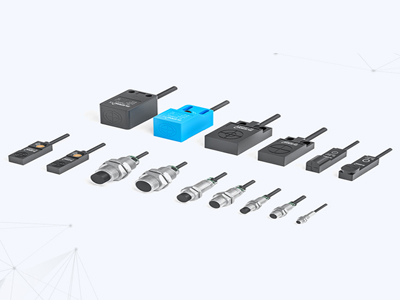
Summary:
A proximity sensor is a device with the ability to sense the proximity of an object. It uses the sensitive characteristics of a displacement sensor to identify the proximity of an object and output the corresponding switch signal, and is therefore often referred to as a proximity switch.
[1] It is a general term for a sensor that detects the movement and presence information of an object and converts it into an electrical signal without touching the object to be detected, instead of a contact detection type detection method such as a switch.
[2] In the JIS specification, the JIS specification (JIS C 8201-5-2 Low-voltage switching devices and control devices, Section 5 Control circuit machines and switching elements, Section 2 Proximity switches) is based on IEC 60947-5-2 for switches for non-contact position detection. In the JIS definition, products that can detect the proximity of an object and the presence or absence of a nearby detection object in a non-contact manner in a sensor are called "proximity switches" and consist of induction, electrostatic capacity, ultrasonic, photoelectric, and magnetic types. In this technical guide, inductive type proximity sensors that detect the presence of metal, electrostatic capacity type proximity sensors that detect the presence of metal and non-metal objects, and switches that use a DC magnetic field generated by magnetic force are defined as "proximity sensors".
Principle:
Detection principle of inductive type proximity sensors
The magnetic loss caused by the eddy current generated on the surface of a conductor is detected by the influence of an external magnetic field. The way to detect the impedance change caused by the eddy current generated by the metal body of the body by making it generate an AC magnetic field in the detection coil and detecting it.
In addition, as another way, an aluminum detection sensor that detects the frequency phase component, and an all-metal sensor that detects only the impedance change component through the working coil are included.
The state of the transformer occurs on the surface of the detection body side and the sensor side.
Special Features:
① Non-contact detection is possible, so there is no abrasion or damage to the object to be detected.
② The contactless output method extends the life (except for the magnetic type), and the semiconductor output has no effect on the life of the contact.
③ Unlike the light detection method, it is suitable for use in environments such as water and oil and is virtually unaffected by stains, oil, water, etc. of the object to be detected during detection. Teflon housing type and products with good chemical resistance are also available.
④ High-speed response compared to contact switches
⑤ A wide temperature range is possible
(6) Detection of changes in physical properties of the test object is not affected by the color of the test object, so it is almost independent of surface color, etc.
(7) Unlike contact, the sensor is affected by the surrounding temperature, surrounding objects, and similar sensors, including induction type and electrostatic capacity type, and the sensors affect each other. Therefore, it is necessary to consider mutual interference for the setting of sensors. In addition, in the induction type, the influence of surrounding metal needs to be considered, while in the electrostatic capacity type, the influence of surrounding objects needs to be considered.
Applications:
Proximity sensors are mainly used to detect the displacement of objects and are widely used in aviation and aerospace technology as well as in industrial production. In daily life, such as hotels, restaurants, garages, automatic doors, automatic heaters are used on the application. In security and theft prevention, such as data archives, treasury, finance, museums, vaults and other important places, are usually equipped with anti-theft devices consisting of various proximity switches. In measurement technology, the measurement of length and position; in control technology, such as displacement, speed, acceleration measurement and control, also use a large number of proximity switches.